
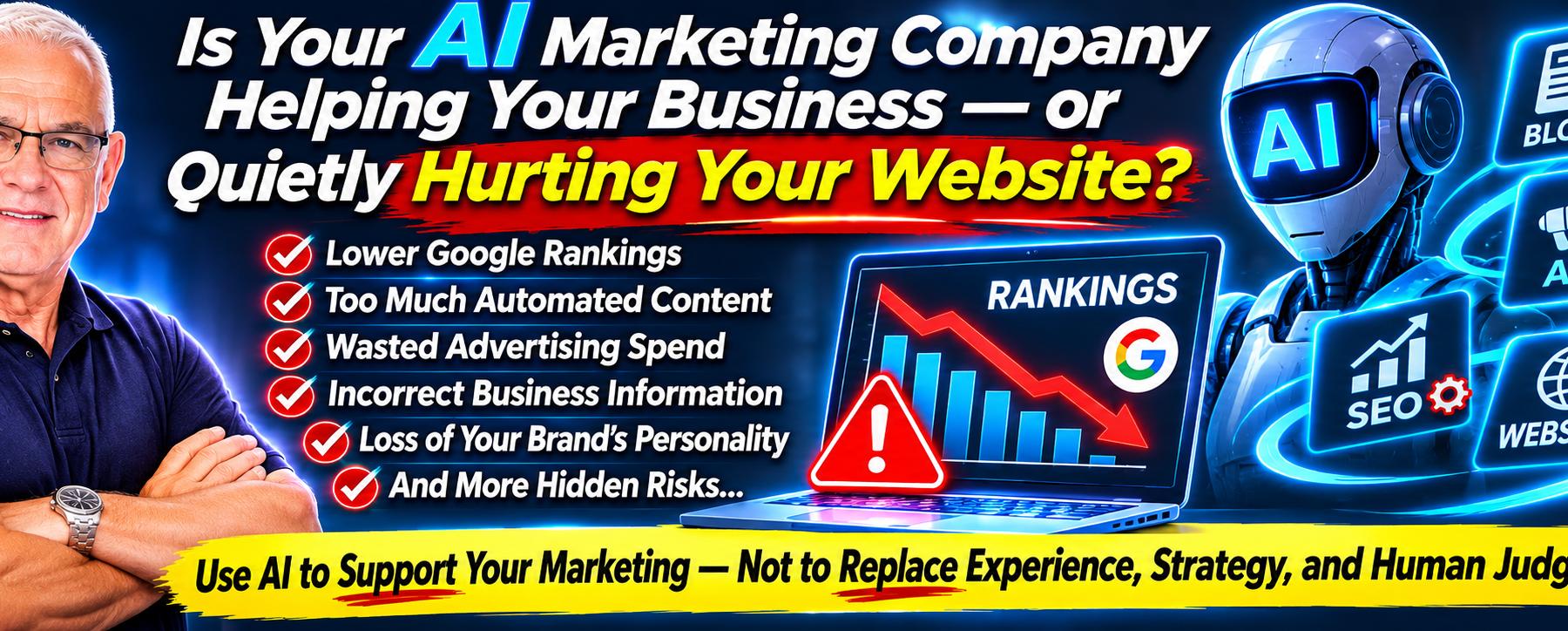
Is Your AI Marketing Company Helping Your Business — or Quietly Hurting Your Website?
The Hidden Risks of Letting Artificial Intelligence Take Control of Your SEO, Website, Advertising, and Online Reputation
Artificial intelligence is changing digital marketing at an incredible pace. Today, companies advertise AI-powered services that promise to manage your website, publish blog articles, improve your SEO, create social media posts, and even run your Google Ads campaigns automatically.
Some promise daily website updates, weekly blog posts, continuous optimization, and better search engine visibility — all with little or no involvement from the business owner.
Sounds wonderful, doesn’t it?
But here’s a question every business owner should ask:
Just because AI can automatically manage your marketing, does that mean it should?
I’ve spent more than 20 years working with websites, search engine optimization, digital advertising, and business marketing. One thing I’ve learned is that successful marketing requires much more than publishing content and changing keywords.
It requires experience, strategy, research, accountability, and a genuine understanding of the business.
AI can be an excellent tool. But allowing an automated system to take complete control of your online presence without qualified human oversight can create serious problems.
Let’s examine what business owners need to understand before turning over their websites and marketing budgets to an AI company.
1. AI Can Damage Years of SEO Work in a Matter of Weeks
Imagine you’ve spent five or ten years building your website’s visibility on Google.
Your website has established pages, valuable content, quality backlinks, and a history of attracting customers.
Then you hire an AI marketing company that promises to improve everything automatically.
The system starts changing page titles, rewriting content, modifying headings, adjusting internal links, and publishing new articles.
But what happens if those changes interfere with pages that were already performing well?
Your website could begin losing rankings, traffic, and potential customers.
Not every AI-generated change is harmful. Some may genuinely improve performance.
The danger is making numerous changes without understanding why the original pages ranked, measuring the results, or maintaining a reliable way to reverse mistakes.
SEO is not simply about adding more keywords.
It’s about understanding search intent, website structure, competition, content quality, technical performance, and the history of the website.
Before changing a page that’s already generating business, you should understand what you’re risking.
2. Publishing More Articles Doesn’t Automatically Mean Better Rankings
Some AI marketing companies promote automatic daily blogging as a major selling point.
Thirty articles a month. Hundreds of pages a year.
But does your business really need that much content?
And more importantly, is anyone verifying whether those articles are accurate, useful, original, and relevant to your customers?
AI-generated articles can sometimes repeat information, target the same keywords, contain factual errors, or provide little value beyond what is already available online.
Google’s spam policies warn against scaled content created primarily to manipulate search rankings rather than help users.
Google does not automatically penalize content simply because AI helped create it. The concern is low-value, manipulative, or unhelpful content.
One excellent article that answers a real customer question can be more valuable than dozens of generic articles published automatically.
Quality should always come before quantity.
3. AI Doesn’t Know Your Business the Way You Do
An automated marketing platform may know your business name, location, services, and industry.
But does it understand why customers choose you over your competitors?
Does it know which services generate the most profit?
Does it understand your staffing limitations, seasonal demand, customer complaints, service areas, or what makes your company different?
For example, an AI system might generate hundreds of visitors to a website by targeting popular keywords.
But what if those visitors are looking for something the business doesn’t offer?
Traffic goes up, but phone calls and sales don’t.
Website traffic means very little if it doesn’t generate qualified customers.
An experienced marketing professional evaluates more than rankings and visitor counts.
The real questions are:
Are customers calling?
Are qualified leads increasing?
Are advertising dollars producing results?
Are visitors becoming paying customers?
Is the business growing profitably?
AI can help analyze these questions, but it still needs accurate data, appropriate goals, and someone who understands the business.
4. Automated Google Ads Can Waste Your Advertising Budget
Google Ads can be an effective way to generate leads and customers.
It can also become expensive when campaigns are poorly managed.
AI-powered advertising tools may automatically adjust bids, targeting, keywords, audiences, and other campaign settings.
Automation itself isn’t necessarily the problem.
The problem occurs when the system is optimizing toward the wrong goal or working with incomplete conversion data.
Imagine paying for hundreds of clicks from people who have no intention of purchasing your services.
Your advertising dashboard may show increased activity, but your phone isn’t ringing.
Clicks are not customers. Impressions are not sales. And automated recommendations are not guaranteed to improve profitability.
A responsible advertising strategy requires accurate conversion tracking, budget controls, search-term analysis, and regular evaluation of lead quality.
Business owners should always know where their advertising money is going.
5. AI Can Publish Incorrect Information About Your Business
Here’s another problem that doesn’t receive enough attention.
AI systems can generate convincing content that contains incorrect information.
An automated system might publish:
Services your business doesn’t offer.
Incorrect pricing or promotional offers.
Unsupported guarantees.
Outdated business information.
Inaccurate statements about licenses or qualifications.
Misleading descriptions of products or services.
For businesses in healthcare, financial services, legal services, and other regulated industries, these mistakes can be especially serious.
Imagine a customer calling to demand a service or price your business never approved.
Or worse, relying on incorrect information published under your company’s name.
Your website represents your business. You are responsible for what customers see, regardless of whether a person or AI system published it.
Every business should have a process for reviewing important content before publication.
6. Your Website Can Lose Its Personality and Competitive Advantage
Take a look at websites in almost any competitive industry.
You’ll often find similar headlines, generic promises, and nearly identical descriptions.
Now imagine thousands of businesses using automated AI systems to generate their content from similar prompts.
What makes one company different from another?
Your experience, customer relationships, reputation, expertise, and unique approach are what make your business valuable.
AI can help communicate those strengths.
But if everything is automated without thoughtful direction, your website can begin sounding like everyone else’s.
Your brand should reflect your business — not just the language generated by software.
7. Who Is Watching When Something Goes Wrong?
This may be one of the most important questions.
Suppose an AI marketing company makes dozens of website changes over several weeks.
Then your Google traffic begins declining.
Who investigates?
Who reviews Google Search Console?
Who checks whether important pages were changed, removed, redirected, or accidentally blocked from indexing?
Who examines your analytics and conversion data?
And who determines whether the decline resulted from the AI changes, increased competition, seasonal demand, a Google update, or another technical issue?
Without careful monitoring, proper documentation, and qualified oversight, finding the cause can become extremely difficult.
Automation should never mean nobody is accountable.
A reputable marketing provider should be able to explain what changed, why it changed, how performance is being measured, and what corrective action is available.
8. What Happens When You Cancel the AI Marketing Service?
Before signing up for an AI-powered marketing platform, ask a question many business owners overlook:
What happens to my website when I stop paying you?
Some marketing services use proprietary software, scripts, hosted content, or subscription-based optimization systems.
Depending on how the service works, certain features or optimizations may stop functioning when the subscription ends.
You need to know exactly what you’re purchasing.
Do you own the content?
Can you export your work?
Will your SEO changes remain in place?
Can you remove the software without damaging the website?
Will you retain access to your Google Ads, Analytics, Search Console, and other business accounts?
Never allow a marketing company to put your entire online business in a position where you cannot operate independently.
Your domain, website, content, and advertising accounts are valuable business assets.
Protect them.
9. AI Companies Can Make Big Promises Without Understanding Your Competition
You’ve probably seen advertisements promising:
“Get to #1 on Google!”
“Automatically dominate your competitors!”
“Let AI handle all your SEO!”
“Generate unlimited leads!”
These claims sound impressive.
But no legitimate SEO professional can guarantee a #1 organic Google ranking.
Your search visibility depends on many factors, including competition, website quality, relevance, technical performance, search behavior, and changes to Google’s systems.
An AI tool can identify opportunities and recommend improvements.
But it cannot guarantee that those recommendations will outperform your competitors.
Be especially cautious when a company promises extraordinary results without first examining your website, competitors, existing rankings, and business goals.
10. The Biggest Problem: Replacing Experience With Automation
Let me make something clear.
I’m not against artificial intelligence.
AI is an important technology, and I believe it can be extremely useful in digital marketing.
I use technology to improve efficiency, research opportunities, solve problems, and help businesses make better decisions.
But there’s a major difference between using AI as a tool and allowing AI to make every important marketing decision.
A software platform can recommend rewriting a webpage.
An experienced SEO professional should ask whether that page is already ranking, which keywords produce conversions, what competitors are doing, and how the proposed changes could affect existing traffic.
AI can generate an advertisement.
An experienced marketing professional should determine whether the advertisement targets the right customers and whether the advertising cost makes financial sense.
AI can publish articles every day.
An experienced professional should determine whether those articles are needed, useful, accurate, and aligned with the company’s objectives.
The real value isn’t how much work AI can produce. It’s whether that work actually helps your business succeed.
7 Questions to Ask Before Hiring an AI Marketing Company
Before giving any company access to your website or advertising accounts, ask these questions:
Will your AI automatically change my website without my approval?
Who reviews the articles, advertisements, and SEO changes before they go live?
Can you show me exactly what your system changed and why?
How do you measure actual leads, phone calls, and sales instead of just traffic?
What happens if my Google rankings or advertising results decline?
Will I retain complete ownership of my website, content, domain, and marketing accounts?
What happens to all the work you’ve done if I cancel your service?
If a company cannot clearly answer these questions, think carefully before giving it control of your business’s online presence.
My Advice After More Than 20 Years in Digital Marketing
Technology will continue changing.
AI will become more powerful, more capable, and more involved in how businesses advertise and compete online.
That’s not necessarily a bad thing.
But business owners need to understand that automation is not the same as expertise.
Your website isn’t an experiment. It’s an investment you’ve spent years building.
Your Google rankings, customer relationships, online reputation, and advertising budget deserve careful management.
Don’t confuse the ability to generate content automatically with the ability to build a successful marketing strategy.
And don’t assume that because a company uses artificial intelligence, it automatically knows what’s best for your business.
Use AI to support your marketing. Don’t let it replace the experience, accountability, and human judgment needed to protect your business.
Need Help Understanding What’s Happening With Your Website?
If you’re concerned about your website rankings, SEO performance, Google Ads, or the recommendations you’re receiving from an AI marketing service, I’m here to help.
I have more than 20 years of hands-on experience in website development, search engine optimization, digital marketing, and technology.
Whether you’re located in Florida or anywhere else in the United States, I can help you better understand your website, identify potential problems, and evaluate your marketing options.
Before you hand over control of your website to an automated marketing system, get a second opinion.
Stan Arnold — Digital Marketing & Website Solutions
Website: https://stanarnold.com
Call Stan: 352-584-5388
If You Need Help, I’m Right Here. Just Call!